In Evolution of Chinese Women’s Clothing, we mentioned how the popular Chinese traditional dress, qipao (旗袍 qípáo) or cheongsam, was in fact brought to China by Manchurians in the Qing Dynasty. Prior to the Manchu occupation, Chinese wore the traditional Han Chinese clothing, which was banned during Manchurian’s rule of China. Gradually, Han Chinese clothing disappeared and the qipao became the iconic Chinese traditional clothing. During the last decade, there has been a movement in China to revive traditional Han Chinese clothing and reintroduce it to modern life. What is Han Chinese clothing, or hanfu (汉服) anyway?
Cultural China gives a simple explanation:
“Hanfu, also known as Hanzhuang or Huafu, refers to the traditional dress of Han Chinese people before Qing dynasty. The term Hanfu derives from the Book of Han, which says, ‘then he (Qu Li) came to the Court many times to pay homage and was delighted at the clothing style of the Han. ‘ Here Han refers to Han Dynasty, but as a matter of fact Hanfu includes not only clothing in Han Dynasty but also in Shang, Zhou, Tang, Song and Ming.”
The article then breaks down the pieces of a typical Hanfu:
“Yi (衣): Any open cross-collar garment, and worn by both sexes
Pao (袍): Any closed full-body garment, worn only by men in Hanfu
Ru (襦): Open cross-collar shirt
Shan (衫): Open cross-collar shirt or jacket that is worn over the yi
Qun (裙) or chang (裳): Skirt for women and men Ku (裤): Trousers or pants
<!--[if !vml]--><!--[endif]-->
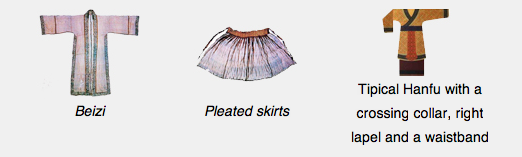
There are two parts overlapping on the front. This is called ‘Jiao Ling’ (Crossing Collar), which is a main feature of nearly all Asian costumes. The order of the two parts is quite important. From the wearer’s point of view, the crossing is always on his/her right side, which is called ‘You Ren’ (Right Front). Therefore an easy way to recognize Hanfu is that its collar forms a ‘y’ shape if you look at the dress from the front.
Hanfu usually has a waistband, on which various little decorations are hung, including Yu (jade) and Chinese knots. These hung decorations, together with the long ribbons and relatively wide sleeves, can sway as one walks. Its idea is to cover up any imperfections and to accentuate the bodily beauty of an East Asian woman.”
There are three basic makes of hanfu, 衣裳制, 深衣制, and 长衫制.
1. 衣裳制 (yīshang zhì), is separated into a top and a bottom piece of clothing.
For Males
For Females, 襦裙 rú qún
2. 深衣制 (shēn yī zhì), where the top and bottom are sewn together into a whole piece.
3. 长衫制 (chángshān zhì), where the top is extended into a long shirt.
直身 zhí shēn (male)
褙子 bèi zi (female)
披风 pīfēng (female)
圆领 yuán lǐng (male)
(By Echo)